

 02/09/2026
  1227
1227

Інтернет-маркетинг
простою мовою
Content of the article
- /01 What is guest posting and how does it work
- /02 Benefits of guest posting for businesses
- /03 The role of guest posting in SEO and Google stance
- /04 How to choose a platform for guest posting
- /05 How to prepare high-quality content for a guest post
- /06 Rules for working with links and anchor text
- /07 Common mistakes and risks of guest posting
- /08 How to evaluate the effectiveness of guest posting

What is guest posting: definition, benefits, and role in website SEO

Guest posting remains one of the most effective tools for promoting a business, yet there are still many misconceptions surrounding it. Attempts to use it as a method for bulk link building no longer work and even pose risks to a website following the latest Google algorithm updates.
In this article, we’ll explore the definition of guest posting, its main marketing and business benefits, as well as its actual role in SEO and the rules for safely selecting platforms.
What is guest posting and how does it work
Guest posting, or guest blogging, involves writing and publishing original, expert content on a third-party niche website that already has an established target audience. Industry media outlets, corporate blogs of partner companies, or specialized analytical platforms are typically used for this purpose.
Unlike spammy link buying on link exchanges, classic guest posting is based on a win-win-win principle (triple mutual benefit). The platform (the host) receives high-quality, unique content free of charge that explores complex topics, engages readers, and fulfills its content plan objectives. At the same time, the author gains access to a new target audience, showcases their expertise, attracts referral traffic, and builds trust in their own brand, while the reader receives verified, practical information that answers their professional questions or solves a specific problem.

In content marketing practice, there are three main formats for this type of collaboration:
- organic (editorial) publication: the author submits exclusive content, and if it meets the publication’s standards, it is published free of charge;
- partner cross-marketing: an exchange of expert columns or research between companies in related niches that share a common audience but are not direct competitors;
- sponsored content: publication on commercial terms, where the platform guarantees placement while maintaining control over the quality of the material.
The main difference between guest posting and regular link building is the priority. In link building, the main goal is simply the presence of a link. In guest posting, the primary focus is on the value of the article for the reader, and the link serves only as a natural, contextual citation.
Benefits of guest posting for businesses
Viewing guest posting solely as a way to build backlinks is a mistake that causes businesses to lose most of its potential. For the B2B segment, SaaS projects, and high-value companies, the primary value of such content lies in marketing and sales.
Attracting high-quality referral traffic
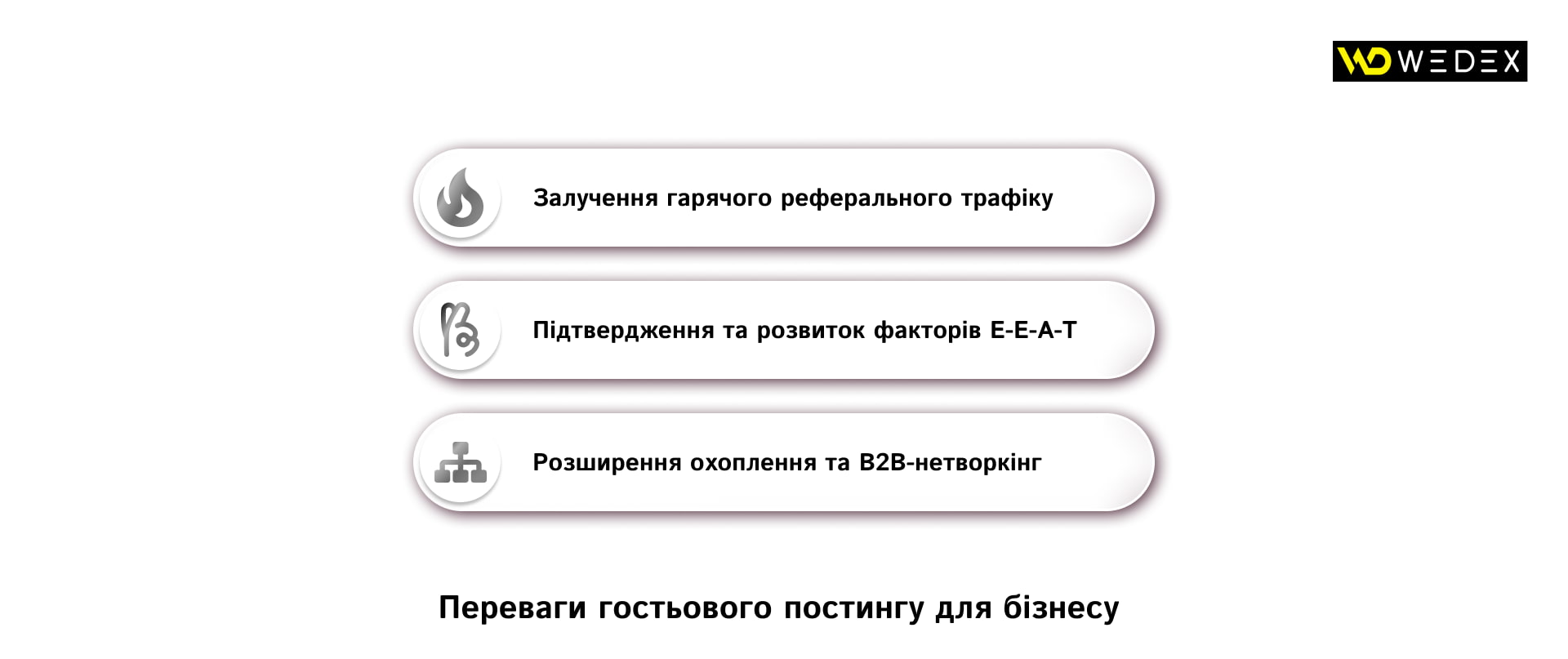
The audience of a reputable industry resource already has a high level of trust in the platform. If, in a guest article, you provide an in-depth analysis of a problem and offer a logical solution, readers will naturally click the link to your website. These aren’t just «clicks» they’re qualified leads with a high level of interest.
Validating and developing E-E-A-T factors
When evaluating websites, Google relies on the E-E-A-T concept (Experience, Expertise, Authoritativeness, Trust). Regular publications by your company’s experts on leading platforms build the brand’s public profile. This enhances the business’s credibility in the eyes of potential buyers and demonstrates to search algorithms that the company is a recognized authority in its niche.
Expanding reach and B2B networking
Your own blog or social media channels are always limited to your existing audience. Publishing on an external platform allows you to reach new market segments. Additionally, communication with editorial teams often develops into long-term partnerships: joint research, webinars, and cross-promotions.
Therefore, it’s important to consider the fundamental difference between the two benefits of guest posting. A business experiences the marketing and PR effects almost immediately after the content is published in the form of referral traffic, new leads, and increased brand trust. In contrast, the SEO impact is cumulative in nature; it unfolds gradually and creates a long-term foundation for the steady growth of the website’s rankings in search results.
The role of guest posting in SEO and Google stance
Despite their marketing value, guest posts are regularly used to support off-page SEO. However, it’s important to understand the line between safe website development and manipulative practices that can lead to issues with search engines.
Google’s official documentation on combating spam states that guest posts themselves do not violate the guidelines. The search engine supports the sharing of knowledge and expertise. However, if the publication of articles becomes widespread and is carried out solely for the purpose of obtaining links with specific commercial anchor text (for example, «buy a cherry picker in Kyiv»), Google classifies such actions as link spam.
Link attributes and their significance
For safe promotion, it’s important to understand the technical purpose of link attributes:
- dofollow (default) passes relative authority (PageRank) from the donor site to your resource; it is used when a site naturally links to a useful source;
- rel=”sponsored” was developed by Google to label links in paid, promotional, or affiliate content;
- rel=”nofollow” instructs search engine crawlers not to pass PageRank to the page the link points to.
The common belief that links with the rel=”nofollow” or rel=”sponsored” attributes are useless for SEO is a myth. Google treats these attributes as suggestions, not strict prohibitions.
The natural backlink profile of any website necessarily contains a mix of link types. If 100% of the links are dofollow, it looks artificial. Additionally, real users clicking on nofollow links send a clear signal to algorithms about the high quality of your site.
Modern algorithms have learned to detect unnatural link schemes. Instead of imposing manual penalties, Google now simply devalues artificial links, rendering the budget spent on spammy posts a waste.
How to choose a platform for guest posting
Selecting platforms is the most critical stage of the strategy. The main mistake many marketers make is blindly relying on private metrics from SEO services, such as Domain Rating (DR) from Ahrefs or Domain Authority (DA) from Moz.
These metrics are calculated by third-party algorithms based on backlink profiles and do not reflect Google’s actual assessment of a website. The DR metric can be artificially inflated by running automated link-building campaigns through private blog networks (PBN), resulting in a high score for a site with no real visitors.
Don’t jeopardize your SEO for the sake of impressive metrics
A high DR doesn’t always mean a high-quality site that’s useful for promotion. Let the experts at WEDEX analyze your backlink profile to develop a safe and effective off-page SEO strategy.
To benefit from this and avoid harming your own site, analyze a potential donor site based on several criteria.

- Analyze organic traffic and assess stability without filters.
Examine traffic history using Ahrefs or Semrush. Traffic should be stable or growing. Traffic should be stable or show gradual growth. If the graph shows sharp and steep drops, this is a major sign that the site has been affected by Google Core Updates or penalized for low-quality content.
- Topic alignment and the relevance of the site’s audience to your niche.
Always prioritize niche-specific resources over general ones. Publishing on a highly specialized blog with 2,000 industry professionals visiting per month will generate significantly more real leads and have a greater promotional impact for your business than posting on a general-interest news portal with 50,000 visitors, where your content will instantly get lost among entertainment-focused material.
- Check outbound links to ensure the cleanliness and health of the backlink profile.
Analyze which sites and with which anchor text the platform links to in its latest posts. If you see frequent mentions of online casinos, microfinance organizations, questionable services, or gray-market niches among the outbound links, it’s best to decline the collaboration. Search engines evaluate the context of links, so appearing alongside toxic resources harms your reputation on Google.
- Strict editorial control ensures there are no signs of a link farm.
Assess the overall quality of the articles on the site. If the platform publishes all texts indiscriminately without verification, editing, or proper formatting literally within minutes of payment, you’re dealing with a link farm. Search algorithms quickly identify such sites and simply devalue all links from them.
- Balance of content and the predominance of original editorial articles over partner content.
A high-quality platform has at least 80–90% of its own editorial content for its readers and only a small portion of sponsored or guest content. Sponsored or guest posts should account for only 10 to 20% of the total. If a site consists solely of sponsored content, it quickly loses visibility in search results.
A site analysis is an evaluation of the resource as a whole. Only a combination of healthy organic traffic, topic relevance, a clean backlink profile, and a strict editorial policy guarantees that the published content will bring real customers to the business and strengthen the site’s position in search results rather than creating additional risks.
How to prepare high-quality content for a guest post
Even if you’ve chosen a platform with high traffic and an excellent reputation, weak or superficial content will negate all your efforts. The days of ordering cheap articles with mechanically inserted keywords for guest posting are long gone.
High-quality guest content is prepared according to three basic rules:
- Adherence to editorial guidelines. Review the platform’s rules before you start writing. If the editorial team requires 5,000 characters, unique screenshots, and a maximum of one link failing to meet these conditions will guarantee rejection.
- Practical value and expertise (E-E-A-T). Share your own experience, statistics, counterexamples, and case studies. The reader should get an answer to a question that can’t be found in the first three search results.
- Seamless integration of links. A link should be a natural extension of the thought or a logical recommendation for an additional source.
Let’s look at an example.
|
Direct advertising (bad) |
«Buy our CRM system at a great price to automate your sales.» |
|
Native approach (good) |
«We discussed how to calculate sales funnel conversion rates in detail in our study of B2B buyer behavior.» |
When you create content that truly solves your audience’s problems, the editorial team itself becomes interested in publishing it, and users are eager to click on the recommended links.
Rules for working with links and anchor text
The technical side of implementing links requires a balanced approach. An incorrectly formatted anchor text is one of the most common signals to Google’s algorithms that a post is artificial.
To build a safe and natural backlink profile, follow this ratio:

- Branded and non-anchor text links (70–80%). These include your company name («according to WEDEX») or a direct URL/link («site.com», «follow this link»). This is the safest approach for Google.
- Contextual phrase anchors (10–15%). A keyword or related query is naturally woven into a longer phrase («in the comprehensive guide to technical SEO»).
- Exact-match commercial anchors (up to 5–10%). Direct commercial queries («website development Kyiv»). Overuse of these can result in penalties under Google Link Spam Update guidelines.
It’s also important to choose the right landing page. Don’t direct all links exclusively to the homepage or services sections. It’s much better to link to useful content on your site: analytics, checklists, or free calculators. This increases the click-through rate of links and builds trust with Google’s crawlers.
Common mistakes and risks of guest posting
Even with a sufficient budget, businesses often make strategic mistakes that render a post useless. Understanding these risks helps protect your company from wasted expenses and penalties from search engines.
- Prioritizing quantity over quality in content and platforms.
Ordering a cheap rewrite of a single article to be distributed across dozens of questionable sites devalues the entire budget. Search engines simply ignore such links using SpamBrain algorithms, so it’s better to publish one high-quality piece on an authoritative resource than ten weak articles on no-name blogs.
- Publishing content on irrelevant or inactive platforms.
Posting an article on a site with high authority metrics but an unrelated or inactive audience will not yield the expected benefits. This will generate neither referral traffic nor real weight for search engine optimization, since Google takes thematic context into account very carefully.
- Failure to regularly monitor articles after publication.
Platforms may later remove links, mark a page with the “noindex” tag, or change its URL without setting up a redirect. Without regular monitoring, you risk losing the backlinks you’ve acquired, so it’s important to periodically check the status of your publications.
Most of these problems can be easily avoided if you treat guest posting as a full-fledged content marketing strategy and work only with trusted platforms.
How to evaluate the effectiveness of guest posting
You need to evaluate the results of guest posting comprehensively, combining marketing, SEO, and PR metrics. Relying on just one criterion will give you a distorted picture and won’t show the real impact on your business. Therefore, the following steps remain important:

To measure marketing traffic and conversions in Google Analytics 4, be sure to use UTM parameters for every link in the article. This allows you to see not only the total number of clicks in the analytics service but also specific actions taken by visitors on the site. For example, if you add the source tag [https://wedex.com.ua/services/seo/?utm_source=dev.ua&utm_medium=guest_post to a link, GA4 reports will clearly show all actions taken by the engaged audience. When 150 visitors come to the site after a publication on dev.ua and three of them submit a request, you get a concrete and measurable result in the form of three hot B2B leads.
At the same time, it’s worth analyzing the publication’s impact on search engine optimization and the site’s ranking in search results. First, use Google Search Console to verify that the page with the article has been indexed within one or two weeks of publication. The next step is to evaluate the increase in your website’s visibility for target query clusters 30 or 90 days after the article’s publication, when the backlink begins to fully pass on its link equity and strengthen the page’s rankings.
The final calculation of financial return on investment is performed using the ROI formula, which allows you to evaluate the effectiveness of the content in monetary terms. To do this, you add up all the costs associated with writing and publishing the text, and then compare them to the revenue generated from the customers attracted. For example, if the costs of creating and publishing an article totaled 12,000 hryvnias, and the revenue from sales to the acquired customers reached 45,000 hryvnias, the calculation yields a 275% ROI, confirming that the content has fully paid for itself and generated a net profit.
So, it’s time to stop viewing guest posting as just another line item in a link-building report or yet another «SEO-optimized» article.
Treat every publication as a long-term digital asset and a permanent ambassador for your brand on someone else’s turf.
While most competitors continue to flood the web with cheap rewrites and look for shortcuts, focus on strong expertise, high-quality platforms, and respect for your readers. Create content that truly solves the market’s problems and then high rankings on Google, customer trust, and steady business growth will naturally follow as a result of your authority.

commercial offer
Other articles by the author

29/09/2026
A content pipeline transforms the creation of content from a spontaneous creative process into a managed production system. In such a system, AI serves as a powerful assistant.

24/03/2026
Today, artificial intelligence enables businesses to generate visuals quickly, scale creative options, and accelerate the iteration process.

27/04/2026
Googlebot is Google Search's primary web crawler. It collects information about web pages so that Google can index them and use them in search results.
Latest articles by #SEO

06/10/2026
From a business perspective, updating content is a sensible way to protect existing investments.

30/09/2026
Google's main focus in 2026 was the large-scale rollout and deep algorithmic integration of the AI Overviews (AIO) tool.
16/09/2026
Choosing between search engine optimization and pay-per-click advertising is one of the most critical decisions when developing a marketing strategy.